James Wendell Gillespie: Physician, Statesman and Soldier
James Wendell Gillespie, born August 9, 1819, was the ninth of eleven children of Colonel George and Anne Neilson Gillespie. The Gillespie family was a wealthy and influential family who owned one thousand acres of land which they called “Euchee Old Fields.” This farm was in the northern end of Rhea County, and was described as “fine farmland.”
James was a brother of Robert Neilson Gillespie who married Hannah Leuty; they were parents of Adelia Gillespie; Adelia married William Perry Darwin. William Perry and Adelia were parents of Ella Adelia, my great grandmother, who married Dr. Walter F. Thomison.
In 1846, James W. Gillespie organized Company H, which served in the Mexican War as part of the First Regiment of Tennessee Mounted Volunteer Infantry. This regiment marched from Memphis to Little Rock, then to Matamoros, Mexico, and to Tampico. He was captain of this company, and was cited for bravery at the Battle of Cerro Gordo.
Gillespie was a member of the Tennessee Legislature and represented Rhea, Bledsoe, Hamilton, Marion, and Meigs Counties in the Tennessee Senate from 1849-1853; represented Rhea, Bledsoe, and Hamilton Counties in the Tennessee General Assembly from 1859-1861. He had been a Union supporter until President Lincoln called for troops to use force against the states withdrawing from the union. Gillespie then changed sides, and supported the South. After that, Governor Isham G. Harris, Tennessee Governor from 1857-1862, appointed him as Inspector General on his staff.
In October, 1861 he resigned from Governor Harris’ staff, and was appointed by the governor to organize Confederate regiments in East Tennessee. Gillespie was elected Colonel of the Forty-Third Tennessee Infantry. This regiment was organized in November, 1861, served in guard duty until it was reorganized in May, 1862. Next, the unit was at Charleston, then was sent to Humphrey Marshall’s brigade in Virginia. Afterward, it joined Bragg’s Kentucky campaign, and was sent to Vicksburg, where the regiment saw hard service. In May, 1863, the regiment went to Port Gibson to resist Grant’s forward march. The Forty-Third was engaged at Piedmont, Winchester, Monocacy, Cedar Creek, Fisherville, White Post, Kernstown, Darksville, and Martinsburg. The Forty-Third returned to East Tennessee in the fall of 1864 and fought at Morristown, then raided Russelville. In the spring the unit served as escort for President Davis, (President of the Confederacy); then was paroled in May, 1865.
Gillespie was wounded twice during his military career, and returned to his home in Washington, Tennessee after the war; he died there October 10, 1873. He is buried in the Mynatt Cemetery in “Old” Washington, Rhea County, Tennessee.
Nancy Brazelton, (1829-1887) daughter of General William and Martha Gillespie Brazelton, married James in 1857; their marriage resulted in two children, William and Kitty. (Both children lived in New Market, Tennessee after their parents died, and were unmarried.) Nancy, their mother, was from New Market, Jefferson County, Tennessee, and was a second cousin of James. However, their common ancestor was married twice, and they each had different maternal ancestors.
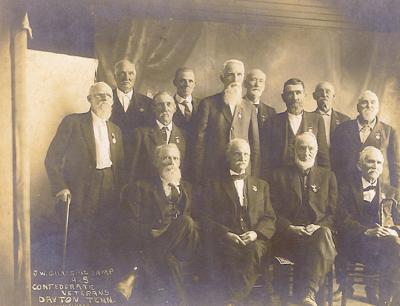
This picture of the J.W. Gillespie Camp of Confederate Veterans shows William Gibbs Allen seated in the front row, third from the left. When this group was organized in 1897, Valentine Allen was Commander; W.G. Allen was Adjutant; the Reverend G.W. Brewer was Chaplain.
And this is only the beginning. . . . . . . There were other Rhea County men who served in Gillespie’s Forty-Third Tennessee Confederate Regiment, or with him in the Mexican War. One of those was William Raleigh Clack, and another was John Spence, who served in Gillespie’s Company during the Mexican War.
Source: Article by Historian as listed above.
