The earliest census has no records for inhabitants in Wollaston Twp until individuals began moving north through Lake and Tudor Twps in the 1860s. The development of the Hasting Colonization Road made travel possible when it reached the area. It was the during the 1870s that the development really took off.
A small community was established in 1879 called Salem, but that name changed when Moses Welsch opened a store and a post office there in 1882 and the community was renamed Welch’s Corners.
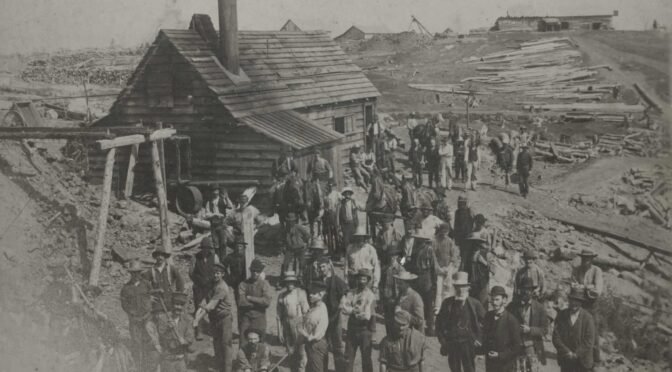
But it was the serious interest in iron ore deposits, discovered by Harry Johnson, that led to the establishment of another village, first called Coe Hill Mines, east of Salem. It was named after William Coe of Madoc who established a business that opened a huge mine and stockpiled thousands of tons of ore in anticipation of the arrival of a train spur. A railway spur was built to Ormsby in 1884, and continued to Coe Hill, now called Coe Hill Junction, to bring the ore to markets.
Meanwhile, lumbering developed. Coe Hill became a main shipping point for the large Rathburn Shipping Company. Up to as many as 100 teams of horses were daily bringing in loads of logs to be cut into lumber or shipped out. There were 520 individuals in the township by 1881.
The iron ore business struggled because of a fluctuating market especially in the States. It never realized the dreams of prosperity that attracted so many in the early days. Yet people continued to arrive in the area. There was a sizeable farming community who helped feed some families or sold produce to others to help make a living. The Wollaston Twp Agricultural Society developed a local fair that drew a large crowd yearly. It continues to this day.
By the turn of the century, in 1901 Wollaston Twp had 818 individuals (of 121 last names), living in 152 houses. By 1911, some 60 or so people had left or died, but the population had a slight increase to 871.
World War I (1914-1919) decimated many communities, and Coe Hill suffered the tragic loss of some of its young men overseas on the battlefields of Europe. It was old Doc Harding, who had strung the first communication wire along the top of fence post to keep in touch with his patients, who had given those boys their physicals and witnessed their signatures on the contracts for war participation. Some men returned home battered and broken. For a short period of time, peace settled back into the township.
By 1931 census there was a small decrease with 854 individuals living within the township of Wollaston.
In 1939, World War II began, and most of the men in the area marched away with the Hastings’ Regiment to serve in Scilly, Italy and the Netherlands. Gratefully, most soldiers came home. They were my neighbours growing up as a child in the village. But we do not forget those who lay buried in cemeteries across the world. The Legion began, and today remains a leader for community activities, the food bank, reunions, wedding receptions and such like.
During a visit in May of 2026, it became obvious to me that the village is slowly dying. It was a shock. There is no store. Bancroft or Apsley, the nearest communities for groceries and hardware, are a half an hour’s drive by vehicle. Yet, I noticed someone had built a new house on Station Street near the Township Office, so hope lingers.
For others who are aging, small gatherings keep the spirit of the community alive. There is a new Fire Hall with trucks and equipment. The main street remains neat and tidy even if the houses are older. Many cottagers happily arrive during the summer to enjoy Wollaston Lake or Dickie Lake. Tourism remains big business in northern Hastings County. The fall fair late August still draws a big crowd.
The rhythm of life is sometimes hidden, unless you live in a place long enough to notice it. Some see it; some do not. Everyone has their own perception, attitude. Coe Hill remain home to me, even though I have been away for over 40 years. I long to see flowering shrubs planted along the perimeter of the cemeteries in the township, as a reminder that there is new life after winter, when spring arrives. May this little village enjoy many happy years ahead.
I saw children at the Legion. A new generation is rising in that quiet, insignificant little place. That gives me and others a quiet satisfaction and joy. Thank you to teachers and staff at the local Public School and Library. Thank you volunteers who watch carefully to protect the community from raging wildfires that threaten so many across Canada.
For those of you who are researching your own family history in this place, remember the pioneers who braved the wilderness to make a beginning, and all those who followed. Let’s keep the memories alive so that the history of this little area might be preserved.